
Boulder, CO 80302, United States, 14th Oct 2026 – GlyphSift, a free, privacy-focused text styling tool based in Boulder, Colorado, has unveiled a browser-based studio that converts plain text into decorative Unicode fonts and characters ready to copy and paste. The studio is intended for people who write for social media, messaging applications and other digital channels, where formatting options are often limited to plain text. It also shows how each conversion is made and how well the resulting characters are likely to be supported in different places.
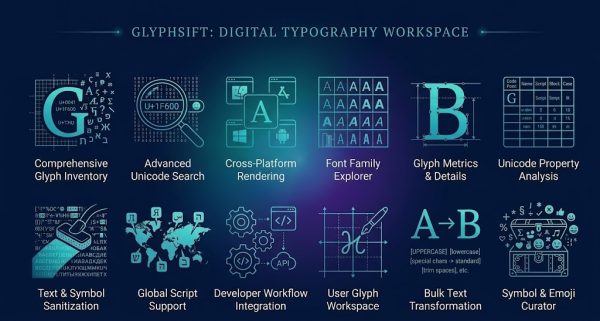
Short-form writing is a routine part of online communication, and many platforms accept only plain text in profile names, biographies and message fields. GlyphSift offers the service as one of many online text styling tools for adding visual variety to names, headings and short messages without installing software.
A Browser-Based Studio for Styled Text
Unicode is the international standard used to encode text across devices and software. It includes blocks of mathematical alphanumeric symbols and other characters whose shapes resemble bold, italic, script and double-struck lettering. These styles are commonly called fancy fonts, although they are technically separate characters rather than fonts. Because they are characters, they remain part of the text when it is copied, whereas conventional font styling usually depends on the application where it was applied.
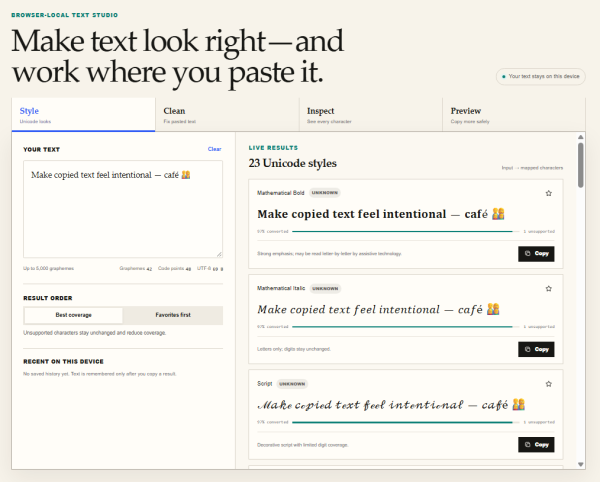
The studio automates the substitution. A user types or pastes text, selects a style, and copies the converted result into another application. In general, each letter of the original text is replaced with a styled counterpart, and the output can usually be pasted into any field that accepts plain text.
“People have long looked for ways to add emphasis and personality to short pieces of text in places that only accept plain text,” said Jack Shi, Founder & CEO of GlyphSift. “The studio was built so that a person can enter a line, choose a style and copy the result within seconds, while seeing exactly what happened to each character.”
Transparency Into Character Conversions
One feature of the studio is the visibility it provides into the conversion process. Rather than returning only the styled output, the tool shows what was changed and how compatible the result is likely to be, so users can see what the conversion involved.
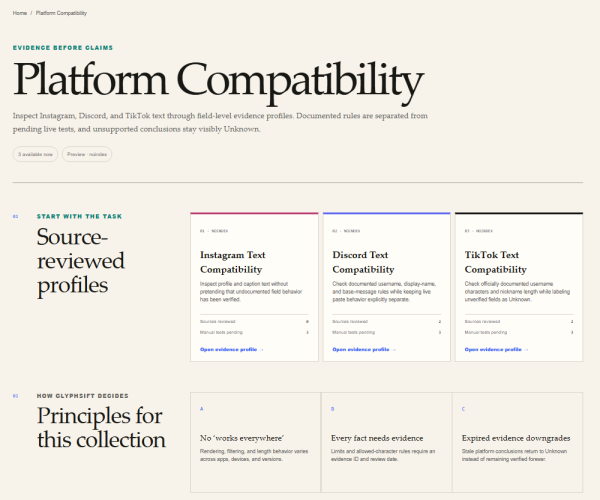
This matters because styled Unicode text does not behave identically everywhere. Display depends on the fonts available on a device and on how an application handles less common characters, and in some cases a character may appear as an empty box or a placeholder symbol. Accessibility is a further consideration. Screen readers and other assistive technologies may read decorative characters differently from ordinary letters, or may not read them at all. Search and text-matching features may also treat styled characters differently from standard letters.
Compatibility information helps users judge whether a particular style suits a particular destination, such as a social media profile, a text message or a document.
Everyday Uses for Styled Text
Styled Unicode text is commonly used in social media profile names and biographies, post headings, message threads and digital content such as titles and captions. Character limits and plain-text fields on many platforms leave little room for typographic variety, which has led some users to rely on Unicode substitutions instead. Short phrases, such as names, headings and single words that need emphasis, are generally the more practical use, while long passages of styled text can be harder to read and less accessible.
The studio runs in a web browser and does not require users to install an application. GlyphSift describes the service as free and privacy-focused.
Looking Ahead
Platform support for Unicode characters differs between services and changes over time, which means compatibility information has to be maintained as well as published. GlyphSift expects to keep updating the studio’s compatibility guidance as platforms change how they display styled characters.
“Support for Unicode characters varies between platforms and changes over time, so compatibility information has to be maintained as well as published,” said Jack Shi, Founder & CEO of GlyphSift. “The intent is to keep the studio clear about what works where, and to keep explaining how each conversion is made.”
About GlyphSift
GlyphSift is a free, privacy-focused text styling tool based in Boulder, Colorado. Its browser-based studio transforms plain text into a variety of decorative Unicode fonts and characters for social media, messaging and digital content, and provides transparency into character conversions and compatibility.
For additional information about copy paste text studio and related industry developments, contact GlyphSift at 1942 Broadway St., STE 314C, Boulder, CO 80302, United States. Inquiries regarding the company’s products and services can be directed by email at support@glyphsift.com.
Media Contact
Organization: GlyphSift
Contact Person: Jack Shi
Website: https://glyphsift.com/
Email: Send Email
Address: 1942 Broadway St.
Address 2: STE 314C
City: Boulder
State: CO 80302
Country: United States
Release id: 49902
View source version on King Newswire:
GlyphSift Unveils Copy-Paste Text Studio for Unicode Fancy Fonts
Disclaimer: The views, suggestions, and opinions expressed here are the sole responsibility of the experts. No Opinion Bulletin journalist was involved in the writing and production of this article.